
What Seniors Should Know Now

THE PROJECTED SHORTFALL
Social Security works mostly on a pay-as-you-go system. That means that current workers pay payroll taxes and then that money goes out directly to pay current social security benefits. For many years, more money came in than went out. That money was saved in the Social Security Trust Fund.
There are three major shifts that are changing the math.
- Baby Boomers are at retirement age (the largest of all our generations)
- People are living longer, every decade sees life expectancy grow
- Birth rates are lower so there are fewer workers paying payroll taxes for each retiree
Social Security is currently paying out more than it collects in payroll taxes. Social Security is pulling out the difference from the Social Security Trust Funds.
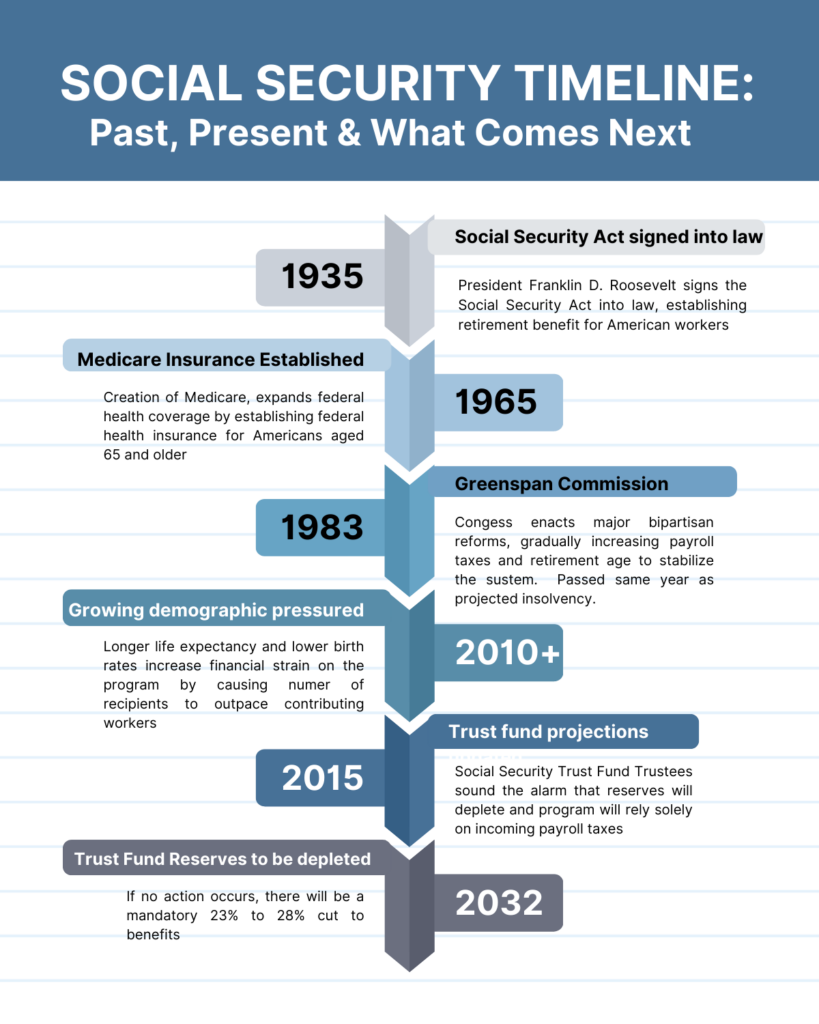
The Trust Fund reserves are projected to be depleted by 2032. At that point, incoming payroll taxes would cover only about 75-80% of scheduled benefits. The Social Security Act requires that social security benefits get paid out of payroll taxes, they cannot add to the general debt.
This is the “shortfall” we are talking about.
WHAT DOES TRUST FUND INSOLVENCY REALLY MEAN?
Once there is no longer savings to draw from, payments will need to match monies being collected through the payroll tax.
It does not mean that social security will go bankrupt. It does not mean that benefits will go to zero. It does not mean that the program disappears.
However, it does mean that benefits will decrease to match the amount coming in directly from payroll taxes IF there is no Congressional action taken. The law requires that benefits match revenue, so until the law is changed, we will see benefit cuts. These benefit cuts could continue to go down indefinitely until Congress takes action.
WHAT CAN CONGRESS DO?
We do not require a new system, the current system works fine. It just requires updates every 50 or so years. The simple options are to increase revenue, lower benefits or a combination of both.
Some options to increase revenue include:
- Gradually increase the payroll tax rate. Current payroll tax rate, since 1990, is 12.4% (split between you and your employer), projections call for an increase of 5.2%, bringing total to 17.6%.
- Lift or eliminate the cap on taxable wages. Currently we tax only the first $176,100 of income, there are proposals to raise that to $250,000
- Broaden the base of income subject to payroll tax. Could major overhaul to tax code allow payroll tax to be applied to investment income?
Options to decrease benefits:
- Gradually raise the retirement age from 67 to 69 or 70
- Modify cost of living adjustments (COLA) by limiting the annual adjustment or removing it entirely for some combination of recipients
- Adjust benefit formulas for higher earners. Anything from using a 40 year average instead of 35 as a way to lower benefits to exploring a flat benefit formula where everyone would receive similar amounts.
Most bipartisan proposals historically combine revenue increases with benefit adjustments. Notably the Social Security Amendments of 1983 was a major reform that combined both.
WHY CAN’T WE WAIT?
The sooner action is taken, the less disruptive the changes will be.
If reforms are enacted sooner:
- Change can be phased in gradually, whether an increase in taxes or a decrease in revenue we would have time to adjust
- The more leverage we have, the better chance we have to protect current Social Security recipients
- Younger workers would have more time to plan whether when to retire or how to change how they save
If Congress waits until the Trust Fund is depleted:
- The required changes will be larger and more abrupt; smaller adjustments spread over many years solve the problem more smoothly than sharp changes implemented all at once
- Lawmakers will face higher political pressure. Seniors and their families will begin panicking, but so will the economy.
- There is less flexibility in how to distribute the adjustments and less opportunity to make the best decision when under pressure.